Inventory levels: reading your stock
Reading your stock, and what to act on.
Do you need this screen
If you sell on demand and hold no stock, mostly no. Your products are bought per order, so there is nothing to run out of.
You will still use it for one thing: packaging stock. If you have had custom packaging made, it lives here and it can run out, which stops orders.
If you hold stock with us, this is the screen you check every week.
The four cards

| Card | What it counts |
|---|---|
| Products in inventory | Everything matching your current search and filters |
| In stock | Ready to fulfil, including items sourced on demand |
| Low on stock | Fewer than 50 units at the warehouse |
| Out of stock | No units at the warehouse |
Two things worth knowing.
In stock includes on-demand items. They are always fulfillable, because they are bought when ordered, so they count as ready even though no units sit on a shelf.
Low on stock means fewer than 50 units. That is a fixed threshold across every product, not a per-product reorder point. A slow seller at 40 units may be months of cover, and a fast one at 60 may be a week. Read the amber flag as a prompt to look, not as an instruction to reorder.
Also note the first card follows your search and filters. Filter the table and it changes.
Reading the table
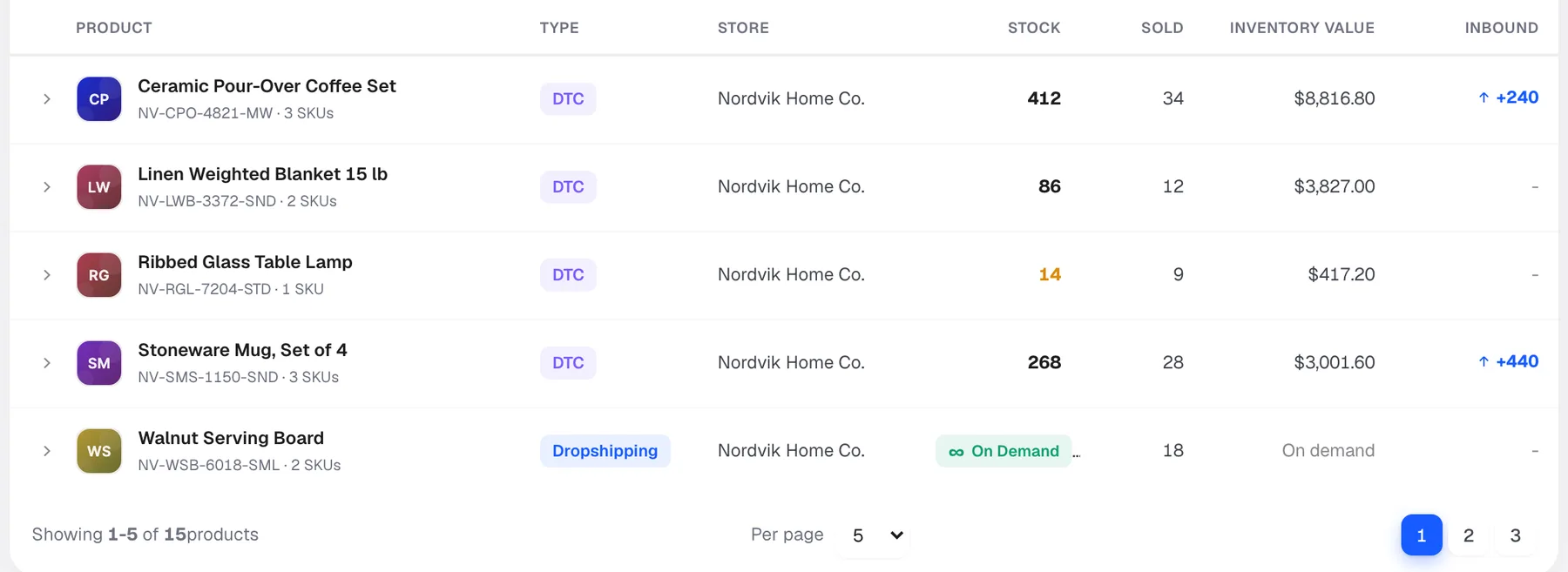
| Column | What it tells you |
|---|---|
| Product | Name, SKU, and how many variants sit under it |
| Type | DTC for stock you hold, Dropshipping for on demand |
| Store | Which store it belongs to |
| Stock | Units on hand, amber when low |
| Sold | Units sold in your selected date range |
| Inventory value | What the stock on hand is worth |
| Inbound | Units on the way, shown with an up arrow |
Expand a row with the chevron on the left to see the individual SKUs under a product. A product reading "3 SKUs" is three variants, and they each have their own stock level. The parent row total can look healthy while one variant is at zero, which is exactly the case that costs you sales, so expand anything you are relying on.
Stock and Inbound together are what you actually plan against. A product at 14 with +240 inbound is not a problem. A product at 14 with nothing inbound is.
Inventory value is the stock on hand at cost. On-demand products read "On demand" here rather than a number, because nothing is sitting in the warehouse to value.
Filters and export
- Search across products, SKUs and inbounds
- Stock filters by state, so you can pull just what is low or out
- Columns shows and hides columns
- Date range drives the Sold column
- Export pulls the table out for your own planning
Weekly habit worth having: set Stock to low and out, look at the Inbound column, and act on anything with nothing coming.
Products, and Inbounds
Two tabs.
Products is what is on hand now.
Inbounds is stock on its way to us, with a count on the tab. See Sending stock to our warehouse.
When stock hits zero
An out-of-stock DTC product cannot ship. Orders for it will not move until stock arrives.
If you are about to run an ad on something at zero with nothing inbound, you are buying traffic for a product you cannot send. Check the Inbound column before you spend.
Two ways to avoid it:
- Watch the low flag and start a new inbound while there is still cover. Factory restock runs 2 to 3 days after production.
- For anything you cannot keep stocked reliably, run it on demand instead so there is nothing to run out of.
Frequently asked
A product says On Demand instead of a number. It is sourced per order, so there is no stock to count. Nothing is wrong.
Can I change the low stock threshold? It is currently fixed at fewer than 50 units for every product.
Does this match my Shopify stock? Stock held with us syncs to Shopify, so what a customer sees on your store reflects what is in the warehouse.
The parent row shows plenty but a customer could not order a size. Expand the row. Variants have their own levels, and one can be at zero while the total looks fine.
What is inventory value based on? Stock on hand at cost.
Still need help?
Real humans on every reply. Average response under 2 hours during business hours.