Dropshipping vs DTC Brand: Which Should You Start in 2026 (and How Each Works From China)
 By Bojan Dimov August 19, 2026 12 min read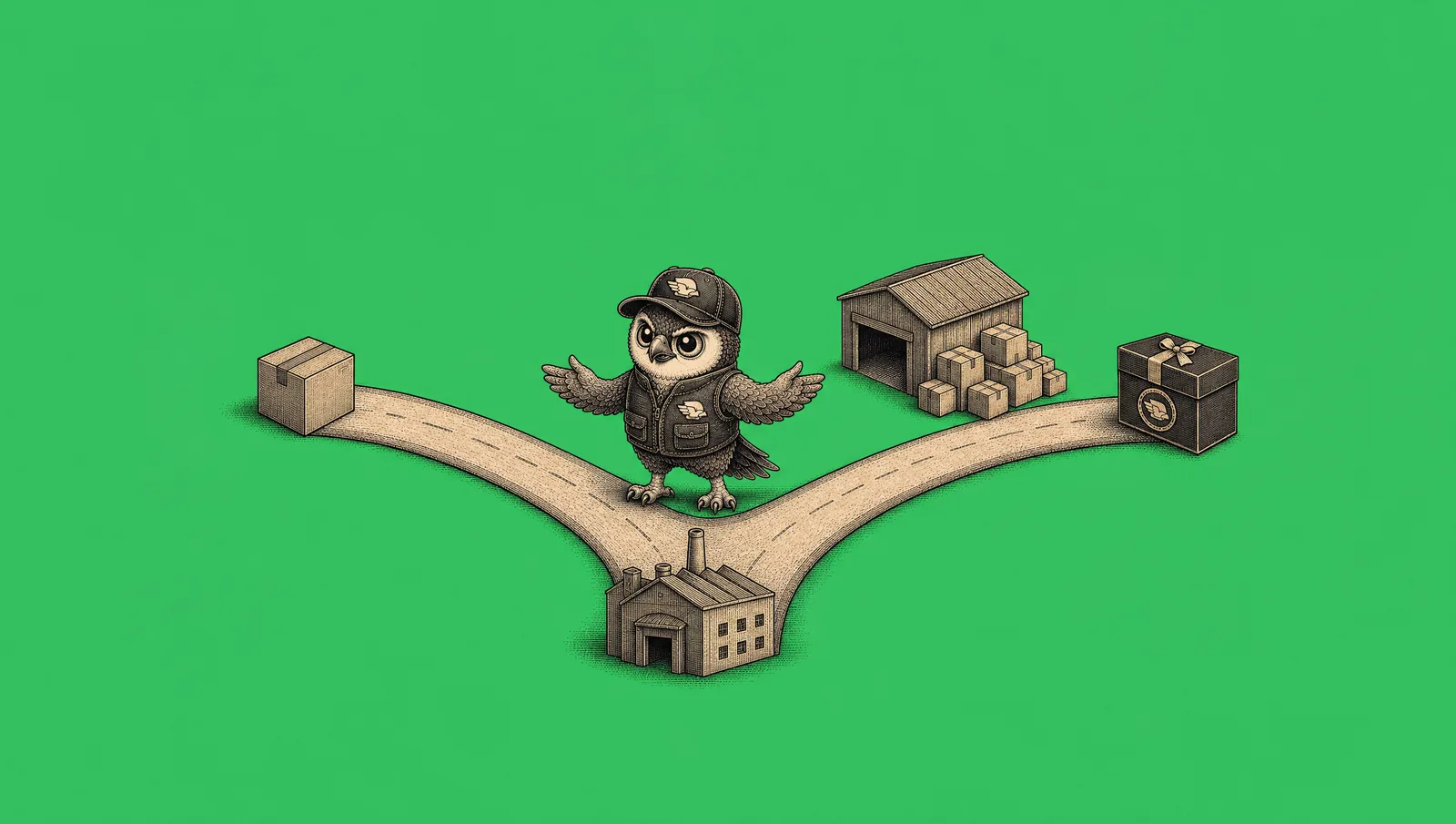
Dropshipping versus private label is usually framed as a choice. It is really a sequence. Dropshipping tests demand with almost no capital: published estimates put startup costs in the low hundreds of dollars, with margins Shopify pegs at 10 to 15% from open marketplaces and 20 to 50% through vetted supplier networks. A DTC brand owns the product, the box, and roughly twice the gross margin, at the price of cash tied up in stock before revenue. Both models run on the same China supply chain, and on our platform, on the same account. Here is how each actually works, with real numbers, and the graduation path between them.
How dropshipping actually works
Strip the guru fog off dropshipping and it is a simple physical loop, and it helps to walk it from the operator side, because we run it daily.
- A customer orders in your Shopify store and pays you at checkout.
- The order routes automatically to the fulfillment platform.
- The product is sourced per order at the factory price, with 0% markup on goods against the 30 to 60% typical of undisclosed agents.
- The unit passes a QC check before it ships (our pass rate runs 99.6%).
- It dispatches in under 24 hours from our Shenzhen warehouse and travels to the customer with local last-mile tracking, averaging 6.6 days on Tier-1 lanes.
At no point did you buy inventory. You never held stock, never prepaid a production run, never rented shelf space. On the Free plan that loop runs at $0 a month with unlimited orders and zero setup fees, paying only when a parcel ships. That is the entire appeal, and it is genuine: the market's own estimates put the cost of starting in the low hundreds of dollars, with Ecommerce.co breaking a typical setup into $0 inventory, $20 to $50 of store setup, and $300 to $1,000 of test ads.
Now the honest catch. The product is generic, which means anyone can sell it, which means your moat is media buying and speed rather than the product itself. Published margin estimates reflect that: Shopify puts open-marketplace dropshipping at 10 to 15%, with 20 to 50% available through vetted supplier networks, while Brand Me Now estimates 10 to 20% for traditional dropshipping and notes a product that looks profitable at 30% gross can drop below 10% after ads. Thin margins are not a flaw in your execution. They are the market pricing a product anyone can source.
How a DTC brand actually works
The brand route changes what you own, and the mechanics change with it.
- You pick and develop the product: spec, materials, variants, and the packaging that makes it yours.
- Samples come first, in 5 to 10 days from verified factories, so you approve the real thing before committing.
- You place a bulk order at factory price, and the stock lands in the warehouse as your held inventory.
- Branded custom packaging goes on, so the box that arrives is your brand's box.
- Orders ship from your held stock, same sub-24h dispatch, and every parcel builds your brand rather than a marketplace's.
What you get for the capital is the whole economic upgrade. McKinsey, writing on distribution, finds private-label products can carry about two times the gross margin of national brands. NYU Stern's industry data (Damodaran, January 2026) shows the same structure: brand-owner sectors like household products and apparel run roughly 51 to 57% gross margins, against 31 to 35% for reseller retail. And the customer becomes yours: research popularised by Harvard Business Review puts acquiring a new customer at 5 to 25 times the cost of keeping one, with a 5% retention gain lifting profits 25 to 95% in Bain's studies. A brand is the machine that makes retention possible.
The honest catch is the cash. Entry estimates run from $1,000 to $5,000 at the low end to Ecommerce.co's $3,000 to $10,000+ for development, sampling, bulk manufacturing and shipping, and Shopify, citing FreshBooks, spans an inventory-holding store as high as $60,000. That money leaves before revenue arrives, and if the product misses, it does not come back. The full mechanics of what held stock does to your cash are in the cash-flow math post.
Worth knowing before you flinch at the risk: own-brand is where the market is going, not a niche bet. US private label sales hit a record $282.8 billion in 2025 (PLMA with Circana data), growing 30% over five years and taking share from national brands, and Numerator finds store brands in 99% of US households.
The Drop
Five winning products every week. Real margins, real factories, ready to import.
How both work from China, side by side
Here is the section none of the comparison posts can write, because they compare abstractions and we operate both models on one platform.
Take the same product, a $6 water bottle from a verified factory, and run it both ways:
| Dropshipping mode | DTC brand mode | |
|---|---|---|
| Where the product lives | At the source, sourced per order | Your held stock in the same warehouse |
| When you pay for a unit | After your customer has paid you | At the bulk order, before any sale |
| Sourcing | Factory price, 0% markup on goods | Same factories, same 0% markup, bulk pricing |
| QC | Checked before dispatch, 99.6% pass | Same check, same number |
| Dispatch | Sub-24h | Sub-24h |
| Delivery | 6.6-day average on Tier-1 lanes, local last-mile tracking | Identical |
| The box | Generic | Your brand, applied per order in the warehouse |
| Capital at risk | Approximately zero | The production run |
| Margin structure | Marketplace-priced, 10 to 50% depending on sourcing (published estimates) | Brand-owner economics, roughly 2x gross per McKinsey |
| Plan | Free $0, unlimited orders | Brand $79 with reserved inventory |
Read the middle rows again, because they carry the point most sellers miss: the logistics do not change when the model changes. Same warehouse, same dispatch SLA, same QC, same tracking. What changes is the inventory model, sourced-on-demand against stock-held, and that is a setting on your account, not a new provider.
Which means the scariest sentence in ecommerce, "we need to migrate our fulfillment," does not apply. You do not switch platforms when you switch models. A SKU that proves itself in dropshipping mode graduates to held stock and branded packaging on the same rails, and restocking from the factory into the warehouse takes 2 to 3 days after production rather than an ocean crossing. The switch is a decision, not a project.
The decision table
| Dropshipping | DTC brand | |
|---|---|---|
| Capital to start | Low hundreds of dollars (multiple published estimates) | $1,000 to $10,000+ typical estimates; up to $60,000 for a fully stocked store (Shopify, citing FreshBooks) |
| Time to first sale | Days: list, test, sell | Weeks: samples in 5 to 10 days, then production |
| Margin per unit | Shopify: 10 to 15% open marketplace, 20 to 50% vetted networks | About 2x national-brand gross margin (McKinsey); brand-owner sectors run 51 to 57% gross (NYU Stern data) |
| Cash-flow profile | Customer pays before you do; near-zero cash in stock | Cash leaves at production, returns at sell-through |
| Brand ownership | None; the product is generic | Full: product, box, customer relationship |
| Risk if the product fails | You stop selling it; nothing sunk | The unsold run is your loss |
| Repeat purchase | Weak, nothing to come back to | The whole game: retention economics compound |
| Who it suits | First-time sellers, testers, wide catalogs | Proven demand, product conviction, $5K+ ready |
The false choice: the 2026 sequence
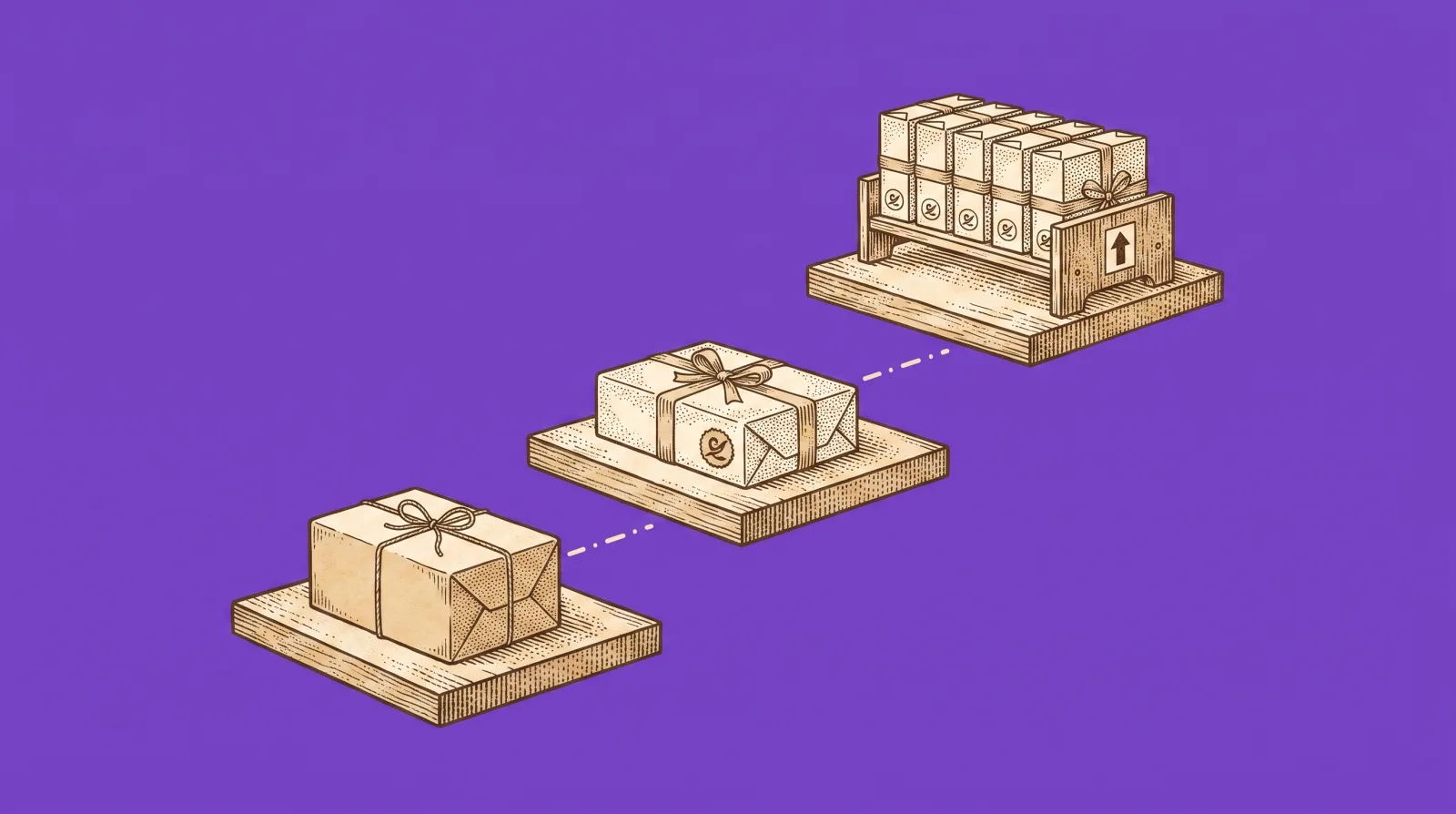
Every ranking comparison post ends with a verdict, and the honest ones all land in the same place: Ecommerce.co concludes there is no best model, only the right model for your stage, and Brand Me Now says start where you can and aim toward ownership once you know what works. We agree, with the operator's version:
Stage one: test per order. Every product starts in dropshipping mode. No capital at risk, unlimited attempts, the market votes with orders. Most products fail here, which is the feature: they fail at the cost of an ad test, not a production run.
Stage two: read the numbers that matter. Guided Success Academy offers 300+ orders a month as its rule of thumb for switching, and it is a reasonable trigger, but volume alone is the weakest signal. The two markers we watch on real accounts: repeat-purchase rate (are people coming back to a product with no brand? then a brand will compound it) and refund rate (brand a problem product and you scale the problem). A SKU with steady orders, organic repeats, and clean refunds is telling you it wants to be a brand.
Stage three: brand the winners. Custom packaging first, because it is the cheapest brand signal with per-order application and no giant packaging run, as covered in custom packaging without a 500-unit MOQ. Then reserved stock for the proven SKUs, so dispatch never waits on sourcing. The plan ladder maps to the same stages, Free to Pro to Brand at $0, $49 and $79, and the SKUs that did not earn branding stay happily in per-order mode alongside.
The sequence is the answer to the title's question. Dropshipping versus DTC brand is not a fork in the road. It is the same road, and the fork picture most articles draw is really a ladder.
Who should start which
Start with dropshipping if you have little capital, no proven product, and a need to learn fast. The tuition is the cheapest in ecommerce: low hundreds of dollars to find out what the market wants. Your lane is dropshipping fulfillment, and the first step is to connect your store.
Start as a DTC brand from day one if you have roughly $5K+ to deploy, genuine product conviction, and ideally demand evidence from somewhere else, an audience, a marketplace test, a previous store. Skipping the testing stage is rational when someone has already done the testing. Your lane is DTC fulfillment, and the right first step is to book an intro call, because a brand launch deserves a human conversation about SKUs, samples and stock levels.
And if you are already doing 50+ orders a day on a generic product, you are not choosing between models. You are overdue. Every day at that volume without a brand is margin left with the marketplace and customers left anonymous. The graduation mechanics above are your map, and the premium dropshipping model is the halfway house you have outgrown.
Frequently asked questions
Is dropshipping or private label better in 2026?
Neither is better in the abstract. Dropshipping wins on capital and speed: startup in the low hundreds of dollars and margins Shopify estimates at 10 to 15% from open marketplaces, up to 20 to 50% with vetted supplier networks. Private label wins on economics: about twice the gross margin per McKinsey, plus the repeat customer. The strongest 2026 pattern is the sequence: test per order, then brand the winners.
How much does it cost to start each?
Dropshipping: published estimates cluster in the low hundreds of dollars, with one typical breakdown at $20 to $50 for store setup plus $300 to $1,000 in test ads and $0 inventory. Private label: estimates range from $1,000 to $5,000 at the low end to $3,000 to $10,000+ commonly, and up to $60,000 for a fully stocked store per Shopify, citing FreshBooks.
Can I turn a dropshipping store into a brand?
Yes, and on the same platform it is a settings change rather than a migration. Proven SKUs graduate from sourced-per-order to held stock with branded packaging, on the same warehouse, dispatch SLA and tracking. Restocking from the factory takes 2 to 3 days after production, so the brand step adds ownership without adding an ocean of lead time.
Do dropshipping and DTC use the same suppliers?
On our platform, yes: both source from the same 30,000+ verified factories at factory price with 0% markup on goods. The difference is purchase pattern, per-order units for dropshipping against bulk runs for held brand stock, which is also why bulk pricing improves as a SKU graduates.
How long does shipping from China take for each?
The same, because the fulfillment rails are shared: sub-24h dispatch from the warehouse and a 6.6-day average delivery on Tier-1 lanes with local last-mile tracking, whether the unit was sourced per order or picked from your held stock.
What margins are realistic?
For dropshipping, treat published figures as a spread: 10 to 15% from open marketplaces and 20 to 50% via vetted networks (Shopify), with other published estimates at 10 to 20% and 15 to 25%. For an own brand, McKinsey finds private label carries about twice the gross margin of national brands, and NYU Stern's January 2026 industry data shows brand-owner sectors at roughly 51 to 57% gross against 31 to 35% for reseller retail. Ad costs eat from both; the brand's cushion is simply thicker.
Best Dropshipping Agents in 2026: An Honest Comparison From Inside the Industry
Nine agents and platforms scored against six checks that predict whether a supplier holds up at scale, using only what each company publishes on its own site. Peregrine is one of the nine, scored by the same rules, including the check where it falls short.
ShipBob Alternative for China-Sourced Brands: When a US 3PL Stops Making Sense
ShipBob runs 50+ fulfillment centers and reports 99.97% accuracy. If your product is made in China, here is the honest cost and cash-timing comparison.
TikTok Shop Fulfillment From China in 2026: The Rules, and the Route That Actually Works
TikTok Shop gives you 2 business days to dispatch and 6 to deliver. Here are the 2026 rules, the cash they demand, and the China-direct route that works.
The Drop
Five winning products every week. Real margins, real factories, ready to import.