The EU €2 Handling Fee Is Set for 1 November 2026: What It Adds to Every Order From China
 By Bojan Dimov October 15, 2026 10 min read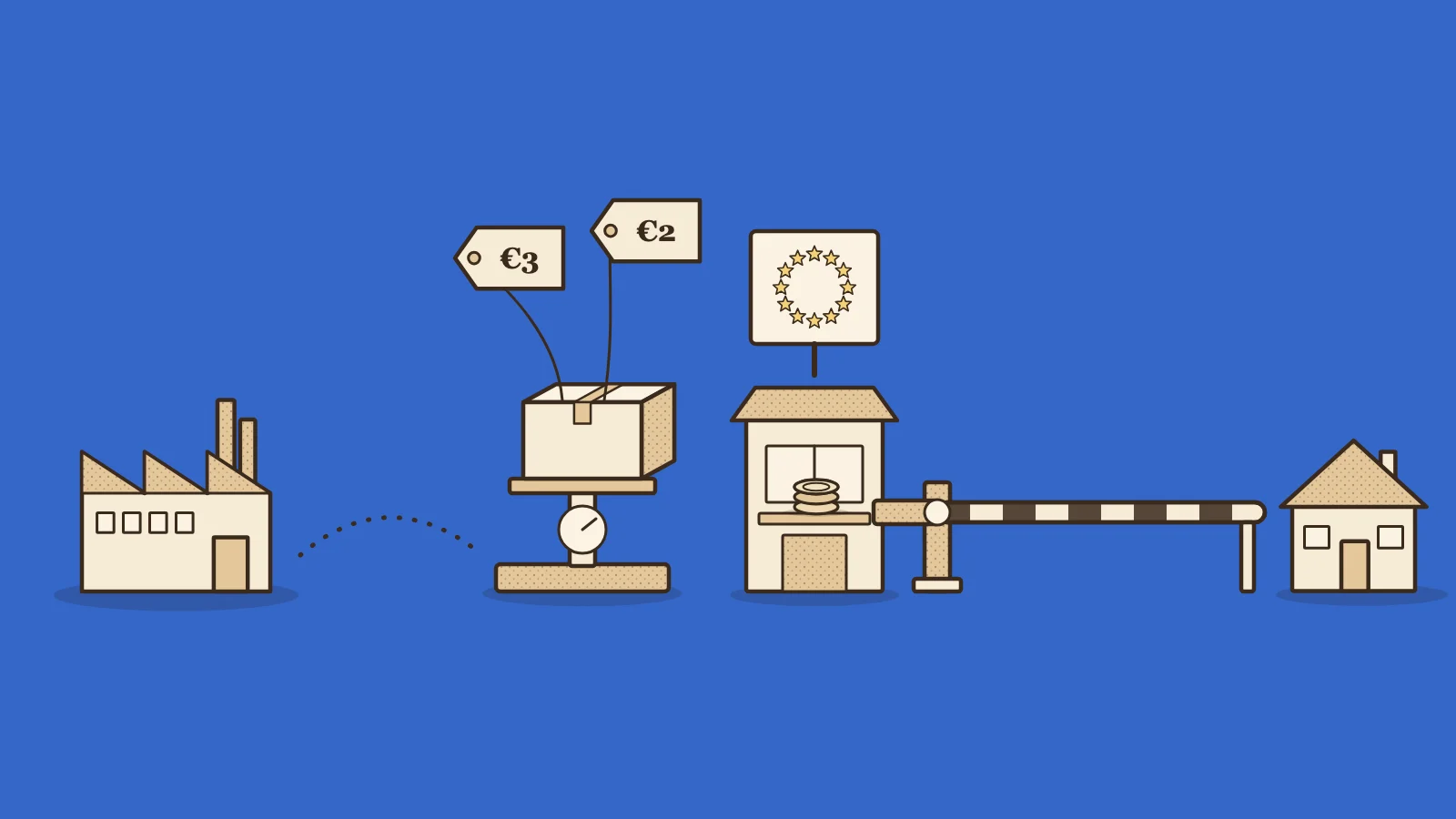
The EU handling fee is a new €2 charge per item on online orders sold to EU consumers from outside the EU, due to apply from 1 November 2026. It applies at any order value, it comes on top of the €3 customs duty per item category that low-value parcels have paid since 1 July 2026, and it is billed to whoever declares the goods to customs, in practice the seller or the platform, not the shopper. For a store shipping from China, every EU order now carries two customs charges before shipping, and both grow with the number of different products in the parcel, not with what the order is worth.
What the EU handling fee is
The Union handling fee, to give it its official name, is a charge for the work customs does on low-value ecommerce imports. The new Union Customs Code, Regulation (EU) 2026/2108, created it, and the delegated act sets the amount: "EUR 2 per item". It applies to distance sales, meaning goods sold online to private individuals, whether they travel by post or by express. Business-to-business shipments and gifts between private individuals are outside it.
It is easy to confuse with the €3 customs duty that took effect on 1 July. They are separate charges, and a typical China-direct order now pays both.
| €2 handling fee | €3 customs duty | |
|---|---|---|
| Amount | €2 per item | €3 per item category |
| In force | Due from 1 November 2026 | Since 1 July 2026 |
| Value threshold | None, applies at any order value | Consignments worth €150 or less |
| Counted per | Item: one declaration line | Item: one declaration line |
| Who pays | The declarant, usually the seller or platform | The declarant, usually the seller or platform |
| Refundable | No, not even on returns | Normal customs rules apply |
| End date | None set, a lower rate for goods sold from EU customs warehouses from 1 July 2028 | Runs until 1 July 2028 |
Two details from the official texts matter for your margins. The law says plainly that "the consumer should not be a debtor" of the fee, so customs bills the business that declares the goods, not your customer. And the Commission's guidance says VAT is due on the fee itself, so in practice it costs a little more than €2.
The reason is volume. The Commission counted close to 5.9 billion low-value ecommerce items entering the EU in 2025, and its figures put China's share of these items at 93%. The €3 duty has already bitten: in July 2026, distance-sale items were 60% lower than a year earlier, though the Commission calls it premature to draw conclusions.
Per item or per parcel? How the €2 is counted
The €2 is charged per item, and in EU customs law an item is a declaration line, not a single unit. The Union Customs Code defines it as goods in a consignment "sharing the same tariff classification, description" and, where declared, origin. Identical units count once. Different products count separately.
National customs authorities say the same thing in plainer words. Ireland's Revenue charges "€2 per distinct item" and treats two identical pens as one item. Dutch customs charges €2 per declaration line and gives an example of 2 trousers, 3 sweaters and 1 pair of shoes: 3 lines, €6. The Commission's guidance adds that the fee applies "per declaration line irrespective of the quantity".
In practice:
- Three identical T-shirts are one item: €2 handling fee and €3 duty.
- Three different products are three items: €6 handling fee and €9 duty.
- A phone case with three identical screen protectors is two items: €4 handling fee and €6 duty.
One caveat. The line count can depend on the type of customs declaration. In the Commission's own example, three suits are a single line on the simplified low-value declaration but three lines on a full declaration, because the full one classifies goods in more detail. On the simplified declaration used for consignments of €150 or less, identical units stay on one line.
The Drop
Five winning products every week. Real margins, real factories, ready to import.


What the EU handling fee adds to a real order
Here are three ordinary orders to Germany, France and the Netherlands. Shipping is our published standard-service price from China for general goods, in US dollars. The EU charges are in euros and are billed separately, so the two are shown side by side rather than added together.
| Order | Weight | Shipping to Germany | Shipping to France | Shipping to the Netherlands | €3 duty | €2 handling fee | EU charges |
|---|---|---|---|---|---|---|---|
| 1 product | 0.3 kg | $9.30 | $9.16 | $9.10 | €3 | €2 | €5 |
| 2 units of the same product | 0.5 kg | $12.00 | $11.80 | $11.73 | €3 | €2 | €5 |
| 3 different products | 0.8 kg | $17.97 | $17.59 | $17.54 | €9 | €6 | €15 |
Standard transit is 5 to 8 days to Germany, 3 to 5 days to France and 3 to 6 days to the Netherlands. VAT is due on top at each country's rate, on the goods and, per the Commission, on the fee.
The pattern is the point. Both EU charges scale with the number of distinct products in the order, not with its value. A €12 impulse buy and a €120 order of one product pay the same €5. A mixed cart of three cheap accessories pays €15, which can be more than the products cost you.
The new product identifier rule
The same date brings a second change that gets far less attention. From 1 November 2026, Delegated Regulation (EU) 2026/1022 makes three product identifiers part of the customs data for every item sold by distance sale. Unlike the fee, this rule is already published law, so it starts on 1 November whatever happens in the scrutiny period.
- Merchant product identifier. Your own reference for the product, typically the SKU in your store. Mandatory.
- Non-standardised manufacturer product identifier. The factory's own model or variant reference. Mandatory.
- Standardised manufacturer product identifier. A barcode number such as a GTIN, EAN or UPC, if the product has one. Where none exists, the declaration uses a code saying so.
The Commission says it is amending the rules so the requirement covers goods of €150 or less, and that business-to-business shipments are in principle not concerned. For a China-direct store, the practical step is a three-line checklist per product variant:
- Your SKU, unique per variant.
- The factory's model or variant reference, taken from the supplier's quote or packing list.
- The barcode number, or a clear note that the product has none.
Keep them in your product data and make sure whoever files your customs declarations has them before 1 November.
How to keep the bill down
You cannot negotiate the fee, but you control most of what triggers it.
- Fewer distinct products per order. Under €150, every extra line costs €5 in duty and fee. A cross-sell of a different €4 accessory can cost more in customs charges than it earns.
- Bundles of one product rather than mix-and-match carts. Identical units share one line. A three-pack of the same item pays €5; three different items pay €15.
- Accurate descriptions and values. Lines are split by classification, description and origin, so precise product data keeps the count honest. The fee is non-refundable even if a declaration is later invalidated, so errors cost twice.
- IOSS registration for VAT. It lets VAT be collected at checkout, so your customer is not billed at the door. Our breakdown of EU de minimis and the €3 duty covers how it works.
- Price the charges in. Put the €5 per line inside the product price or a clear shipping line rather than surprising the shopper. Our free dropshipping calculator shows what a product needs to sell for once every cost is in.
Product choice matters more than it did. For more on picking markets and products that clear the new bar, see dropshipping in Europe.
What changes next
From 1 July 2028 a lower handling fee applies to goods sold from EU customs warehouses, an amount the Commission has not yet set. The flat €3 duty is due to end on the same date, with the Commission assessing by 1 December 2027 whether the new customs IT system will be ready and whether to propose an extension. The EU Customs Data Hub also becomes mandatory for ecommerce from 1 July 2028. The €2 handling fee itself has no end date.
How Peregrine fits
Customs charges are now the same law for every seller shipping into the EU, so the difference a fulfillment partner makes is everything around them. Peregrine works on 0% markup on goods, with the per-order rate charged only when a parcel ships. Orders leave our Shenzhen warehouse with sub-24h average dispatch, and delivery takes 3 to 10 days on Tier-1 lanes. Our pricing page sets out the plans.
The EU handling fee does not end selling into Europe from China. It ends the mixed cart of cheap accessories, and rewards stores that sell fewer, better products per order.
Connect your store to route your EU orders, or see shipping rates for every European lane.
Last reviewed 15 October 2026.
Frequently asked questions
Is the EU handling fee charged per item or per parcel?
Per item, and an item is a declaration line: goods sharing the same tariff classification, description and origin. Identical units count once, so three identical T-shirts pay €2, while three different products pay €6. Irish and Dutch customs both describe it this way.
Who pays the EU handling fee?
The declarant, which is the business that declares the goods to customs, usually the seller or the platform. EU law says the consumer is not a debtor of the fee, although the seller can pass the cost on through the price.
Does the EU handling fee apply to orders over €150?
Yes. The fee has no value threshold and applies to distance sales at any value. The €150 limit belongs to the separate €3 customs duty; orders above €150 pay normal customs duty plus the €2 fee per item.
Is the EU handling fee refunded if the order is returned?
No. The law states that the fee is non-refundable. Dutch customs confirms there is no refund for failed delivery, refusal or a return, and the Commission says it stays due even if the declaration is later invalidated.
Is the €2 handling fee on top of the €3 EU duty?
Yes. On a consignment worth €150 or less, each item pays the €3 customs duty and the €2 handling fee, so a single-product order pays €5 in EU charges before VAT. The Commission says VAT is also due on the fee.
Does the EU handling fee apply to the UK, Norway or Switzerland?
No. The fee is charged when goods are released into the EU customs territory, which does not include Great Britain, Norway or Switzerland. How it applies to Northern Ireland is still being settled.
Holiday Returns 2026: Handling the January Wave When Your Product Ships From China
Retailers expect 17% of holiday sales to come back, mostly in January. How to handle holiday returns when shipping back to China costs more than the product.

Batteries, Liquids and Cosmetics: What You Can Actually Ship From China (and How)
Batteries, liquids and cosmetics are rarely banned. They are misrouted. The IATA rules, the FDA and EU cosmetics files, and the lanes that carry them.

EU De Minimis Ends July 1, 2026: The €3 Parcel Duty and How to Keep Shipping China-Direct to Europe
On July 1, 2026 the EU ends the €150 duty-free threshold and charges €3 per item on low-value parcels. The per-item math that decides who stays profitable, and how to keep shipping China-direct to Europe.
The Drop
Five winning products every week. Real margins, real factories, ready to import.