Express vs Standard Shipping from China: When Paying for Speed Actually Pays Off
 By Bojan Dimov September 5, 2026 9 min read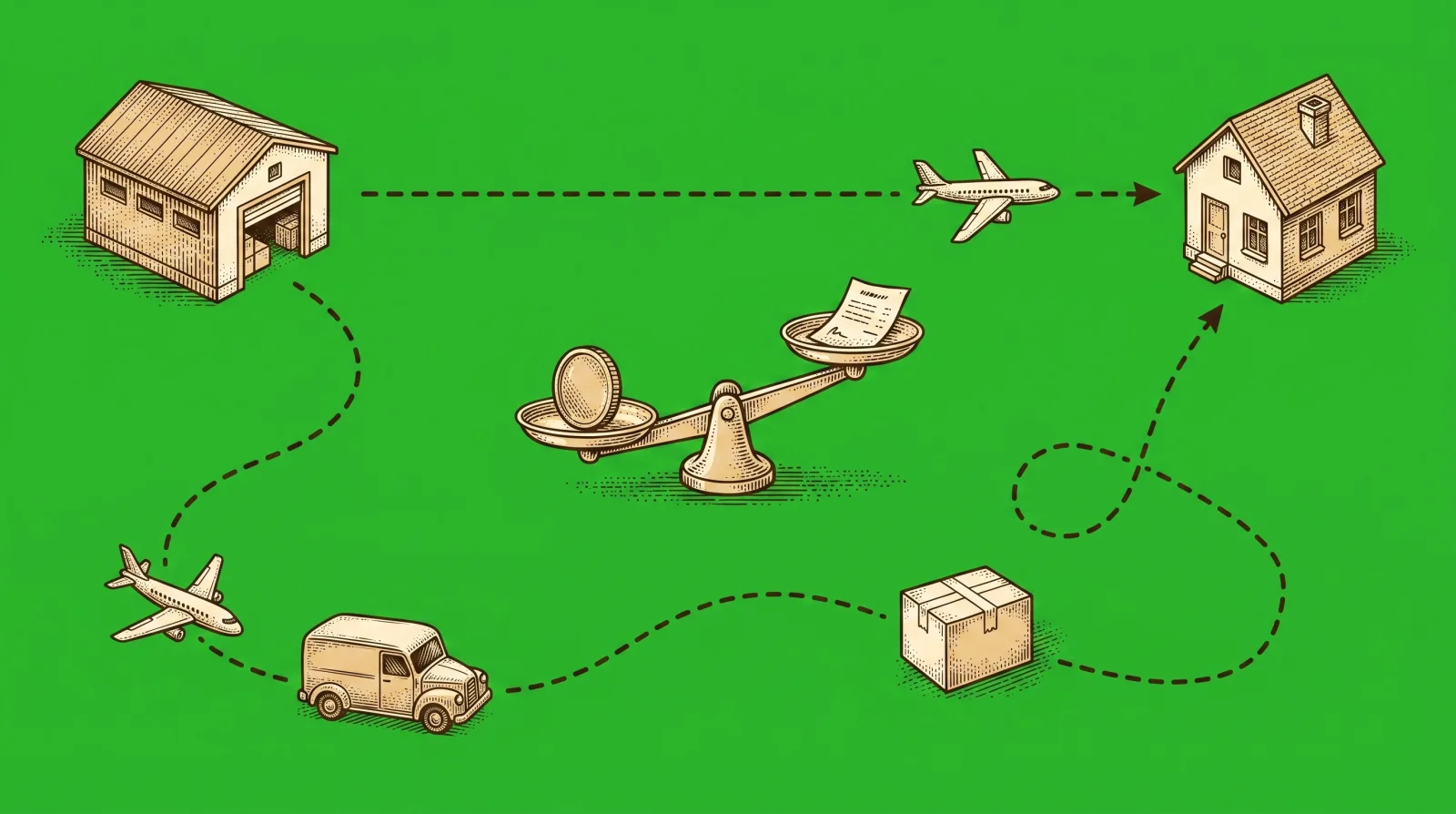
Standard shipping from China is an air-and-postal service that delivers in roughly 4 to 8 days to the United States; express is a priority air service that delivers in 3 to 6. The price gap between them is smaller than most sellers assume, and it shrinks as a share of the sale as order value rises. The decision rule fits in one line: express is worth it when the delivery window changes whether the customer keeps the order, not when it simply feels faster. This post gives the real transit windows by lane, the actual price difference at a stated weight, and the economics of slow delivery that nobody else writes down.
Express vs standard, defined
For a China-origin parcel, both services share the same first step: the order is picked, checked and dispatched from the warehouse. What differs is the route after that.
Standard consolidates parcels onto scheduled air capacity, clears customs in bulk at the destination, and hands each parcel to the local last-mile carrier, whose name is what appears on your customer's tracking. It is the workhorse of cross-border ecommerce. Express moves the parcel on priority air capacity with faster handling at each handoff, then hands to a local carrier or express network for delivery. Fewer days in transit, more cost per parcel. Economy sits below both, trading more days for the lowest price.
The thing to hold onto: on every service, your customer's tracking ends on a local carrier. Speed is bought in the middle of the journey, not at the door.
Real transit times from China by lane
These are our door-to-door windows by lane, as published in the shipping calculator. Dispatch happens first, in under 24 hours on average, and then transit begins.
| Lane | Economy | Standard | Express |
|---|---|---|---|
| United States | 7 to 12 days | 4 to 8 days | 3 to 6 days |
| United Kingdom | 5 to 8 days | 3 to 5 days | 2 to 4 days |
| Germany | 8 to 12 days | 5 to 8 days | 4 to 6 days |
| France | 6 to 10 days | 3 to 5 days | 2 to 4 days |
| Australia | 7 to 11 days | 4 to 7 days | 3 to 5 days |
| Canada | 9 to 13 days | 6 to 10 days | 5 to 7 days |
Two reads. The gap between standard and express is usually one to two days at each end of the window, not a week. And the lanes differ more than the services do: UK and France standard beats US express on paper, because the customs and last-mile handoff is faster there. Our overall average across Tier-1 lanes, dispatch and transit combined, is 6.6 days.
What the speed upgrade actually costs
A flat dollar premium is not decidable. A percentage of the sale is. Here are live examples from the shipping calculator for a 0.5 kg general-goods parcel, end-customer prices:
| Lane, 0.5 kg | Standard | Express | Premium |
|---|---|---|---|
| United States | $15.09 | $17.38 | $2.29 |
| United Kingdom | $11.63 | $12.45 | $0.82 |
| Germany | $12.00 | $12.82 | $0.82 |
Now put that US premium against the sale it protects:
That is the whole basis of the decision. On a $35 order the premium is a real 6.5% of revenue and needs justifying. On a $150 order it is 1.5%, less than a single refund would cost you in a year of orders. The premium is fixed per parcel; the value it protects is not. Run your own weight and lanes through the calculator, and remember electronics and battery goods carry a 1.18x multiplier on every service.
The Drop
Five winning products every week. Real margins, real factories, ready to import.



When speed pays: the economics nobody writes
Everyone compares express and standard on price and days and stops. The real comparison is the express premium against what slow delivery costs you, and slow delivery costs money in four places.
1. Refunds that start the moment an estimate passes. In Baymard's 2025 US survey, 20% of shoppers who abandoned a checkout said delivery was too slow. That is lost sales before shipping even happens. After the sale, the clock is the estimated delivery date: in Narvar's 2025 survey of 3,461 US shoppers, 73% said an estimated delivery date affected whether they bought, and a missed one is when the refund emails begin.
2. Chargebacks filed against orders that arrive late. Under Visa's rules, a cardholder can dispute a non-delivered order up to 120 days after the date they expected it to arrive, capped at 540 days from the transaction. Slower shipping extends that exposure window. Stripe's documentation says merchants usually get 7 to 21 days to respond and a dispute takes two to three months to close, with a non-refundable fee charged the moment a dispute is received. And in the Merchant Risk Council's 2025 survey of 1,082 merchant fraud professionals, half had faced false claims that goods were not received in the past year. Late parcels make those claims plausible. The per-order math is in chargeback math for slow shipping.
3. Negative reviews that raise the cost of every future sale. In Descartes' 2024 study of 8,000 consumers in Europe and North America, 67% had experienced a delivery problem, and 63% of those did something that hurt the retailer or carrier. A review is the cheapest thing an annoyed customer can do, and it taxes your conversion rate on every order after.
4. Lost repeat purchase, where lifetime value actually dies. Narvar's finding is the one to write on the wall: half of consumers say a late delivery makes them less likely to shop with that retailer again, and 6% say they stop for good. Only 40% of 18 to 29 year olds say they would shop again after a missed estimate. Your acquisition cost bought a customer; a late parcel gives them back.
The decision rule. Take your average order value and multiply by your gross margin. Estimate, honestly, how much likelier a customer is to refund, dispute, review badly or not return when the parcel takes eight days instead of four. Even a few percentage points of lost repeat purchase on an $80 order dwarfs a $2.29 premium. Where the premium is under about 3% of the sale, express is usually the cheaper option once these four costs are counted. Where it is 6% or more, the next section applies. The wider return-rate math is in how we cut returns from 8 to 2 percent.
When standard is the right call
This is the section that keeps the article honest rather than an upsell.
Standard is right on low order values, where a $2 premium is a meaningful share of a thin margin and the customer's expectations are calibrated to the price. It is right for patient categories: replacement parts, hobby supplies, anything bought on a plan rather than an impulse. And it is right whenever the customer was told a realistic window up front, because Narvar's data says the estimate is what matters, not the raw speed. A parcel that arrives on day seven of a promised five-to-eight-day window is on time. A parcel that arrives on day five of a promised three-day window is late.
Setting an accurate expectation beats buying speed you do not need. If your product page says "ships from our warehouse, 4 to 8 days," standard keeps that promise at the lowest cost, and express is money spent on a problem you do not have.
How we route each order
From the Shenzhen floor: every order is checked and dispatched in under 24 hours on average, and the service is selected per lane rather than globally, because as the transit table shows, a UK standard parcel already beats a US express one. Each parcel finishes on the local last-mile carrier in 65+ countries, so the tracking your customer sees is the name they trust, on one tracking page. Delivery accuracy runs 99.8%, and the average across Tier-1 lanes, dispatch and transit together, is 6.6 days.
That is the full-service version of the decision rule in this article: pay for speed where speed protects the order, and not where it does not. The lane windows and end-customer prices for every destination are published in shipping coverage, and the operational detail of the stack is in China-direct 3PL fulfillment.
See where and how fast we deliver: see coverage for every lane, or connect your store to route live orders.
Last reviewed 5 September 2026.
Frequently asked questions
What is the difference between express and standard shipping?
Standard consolidates parcels onto scheduled air capacity, clears customs in bulk and hands to a local last-mile carrier, typically 4 to 8 days to the US from China. Express uses priority air capacity with faster handling at each handoff, typically 3 to 6 days to the US. Both end on a local carrier; the speed is bought in the middle of the journey, and the price gap is usually a few dollars per parcel.
How long does standard shipping take from China?
Door to door, from our warehouse: 4 to 8 days to the United States, 3 to 5 days to the United Kingdom and France, 5 to 8 days to Germany, 4 to 7 days to Australia and 6 to 10 days to Canada, after dispatch in under 24 hours on average. Economy services add several days to each; express removes one to two days at each end of the window.
Is express shipping worth it for dropshipping?
When the delivery window changes whether the customer keeps the order. On a 0.5 kg parcel to the US the express premium is about $2.29, which is 6.5% of a $35 order and 1.5% of a $150 order. Judge that premium against refunds, chargebacks, negative reviews and lost repeat purchase from slow delivery, not against the standard rate. Under roughly 3% of the sale, express usually wins.
Why does express shipping from China cost more?
Priority air capacity, faster handling at each handoff, and smaller consolidation batches all cost more per parcel than scheduled capacity and bulk customs clearance. Weight drives the price on every service, and electronics and battery goods carry a 1.18x rate multiplier because of handling requirements. The premium is fixed per parcel, which is why it shrinks as a share of the sale as order value rises.
Can I offer free shipping and still use express?
Yes, if the order value carries it. Free shipping is a pricing decision, not a service decision: the shipping cost is inside your product price either way. On higher-value orders the express premium is a small share of the sale, so building it into the price and offering free express is often cheaper than the refunds and lost repeat purchases that slow delivery causes.
Which shipping option is best for high-value products?
Express, almost always. On a $150 order the premium is about 1.5% of the sale, while a single chargeback or lost repeat customer costs many times that. High-value orders also attract more scrutiny from customers watching the tracking, so a shorter window reduces the days in which a dispute can start. For very high values, add signature on delivery.

2026 Peak Season Surcharges: What UPS, FedEx and USPS Are Charging, and How to Price Around Them
UPS, FedEx and USPS peak surcharges run 27 September 2026 to 17 January 2027. The dates, the increases, and how to price shipping so they don't eat your margin.

Where Is My Order? How to Cut WISMO Tickets During Black Friday
"Where is my order?" tickets spike every Black Friday. How to cut them with honest delivery windows, proactive updates and tracking customers can read.
3PL Fulfillment Pricing in 2026: China vs the United States vs Europe
Every 3PL bill is built from the same five components. What changes by region is the pricing model: published China rates near $0.99 per order, US surveys at $3.20 plus a storage meter, and Europe mostly quoting in private. All three priced from named sources, with the 2026 duty rules that changed the answer.
The Drop
Five winning products every week. Real margins, real factories, ready to import.