3PL Fulfillment Pricing in 2026: China vs the United States vs Europe
 By Bojan Dimov August 19, 2026 14 min read
Every 3PL bill on earth is built from the same five components: receiving, storage, pick and pack, packaging, and last-mile shipping. What changes by region is the pricing model. Published China rates run around $0.80 to $0.99 per order picked and packed with storage near $15 per CBM per month, US surveys put pick and pack at $3.20 per order with $20 per pallet per month storage, and most European 3PLs publish no prices at all. The cheapest region is not a constant: it depends on where your goods are made and what your customer expects. This guide prices all three, from named public sources, and then shows the duty rules that quietly changed the answer in 2026.
The five components every 3PL bill contains
Strip any fulfillment quote to its skeleton and you find the same five lines. If a quote hides one of them, that is where the margin lives.
| Component | What it covers | What drives it |
|---|---|---|
| Receiving | Unloading, counting, shelving your inbound stock | Labor time per pallet or carton |
| Storage | The space your inventory occupies, billed monthly | Warehouse rent, and how long stock sits |
| Pick and pack | Pulling units for an order and boxing them | Labor cost per touch, order complexity |
| Packaging materials | The box, mailer, filler, label | Materials, plus branding if custom |
| Last-mile shipping | The carrier leg to your customer's door | Weight, distance or zone, destination country |
| Surcharges | Peak season, oversize, batteries, long-term storage | The exceptions your product triggers |
Regions do not just charge different amounts on these lines. They charge on different models. US 3PLs typically bill storage monthly whether you sell or not, plus a fee per pick. Chinese fulfillment centers lean on a per-order consolidation model: the bill arrives when an order moves, and several publish zero receiving fees and no monthly minimums. Europe prices highest on the labor-heavy lines and, most often, does not publish prices at all.
What 3PLs charge in each region, from published sources
Every figure below is from a named public page or survey, with its date. Where a region's providers do not publish, the table says so, because that fact is part of the comparison. Currencies are left in their original units deliberately.
| Component | China (published examples) | United States (published) | Europe (published) |
|---|---|---|---|
| Pick and pack | $0.99 per order (china-fulfillment.com, Aug 2026); from $0.80 per order (Fulfillment-Box, Aug 2026) | $3.20 to $3.25 per order (2025 survey of 600+ warehouses, The Fulfillment Advisor) | Rarely published; byrd and Monta state quote-only pricing |
| Storage | $14.70 per CBM per month (china-fulfillment.com); $19.00 per pallet per month (Fulfillment-Box); 30 days free then $37.50 per CBM per month (NextSmartShip) | $20.17 per pallet per month, or $0.46 per cubic foot (same survey); Amazon AWD $0.48 to $0.57 per cubic foot (Amazon) | Amazon FBA UK £0.76 per cubic foot per month, rising to £1.51 in Oct to Dec (Amazon UK, 2026) |
| Receiving | Zero at some providers (china-fulfillment.com); $0.11 per item (Fulfillment-Box) | $10.52 per pallet, $500 per container (same survey) | Not published by most providers |
| Minimums | Mostly none stated | $517 minimum monthly spend (same survey) | Huboo starts at £1,000 per month, an entry floor rather than a rate |
(As of August 2026. Published prices are ceilings and marketing anchors, not negotiated rates. One China provider's free-storage offer converts to the market's highest per-CBM rate once the free window lapses, so promo windows are not rates.)
Three structural reads from that table, which matter more than any single cell:
- The models differ more than the numbers. A US 3PL's storage meter runs whether you sell or not, and its survey-average minimum spend rose 53% year over year to $517. The Chinese per-order model attaches cost to an order that already has revenue against it.
- Europe's silence is a price signal. When byrd writes that it offers no generic pricing and Monta says the same in Dutch, the honest conclusion is that European fulfillment is quoted, not listed. The published anchors that do exist, Amazon UK's storage card and Huboo's £1,000 entry floor, sit at the top of the global range.
- The input costs explain it. Average hourly labour cost is €34.9 across the EU (Germany €45.0, Netherlands €47.9, Poland €19.1, 2025, Eurostat), against a Chinese transport-and-storage sector average of 133,981 yuan per year in urban non-private units (NBS, 2025). Prime logistics rent runs €10.70 per sq m per month in Munich (JLL, Q1 2025) and £28 per sq ft per year in London (Knight Frank, Q1 2026), while Poland sits at €4.50 to €5.50 per sq m per month, which is exactly why EU fulfillment keeps migrating east. Labor and rent are the bill. The bill follows them.
Storage, put on one honest axis
Storage is the line where units hide the truth: China quotes per CBM, America per cubic foot, and one CBM is 35.3 cubic feet. Converted onto one axis:
The orange bar is the one to remember. Amazon's US peak-season storage is 3.08 times its base rate, and it lands in exactly the quarter you hold the most stock. Storage is not a fee. It is a meter that runs fastest when you can least afford it.
The Drop
Five winning products every week. Real margins, real factories, ready to import.



Why the same product costs different money from each region
Take one product, made in China like the majority of ecommerce goods, and follow the money through each route.
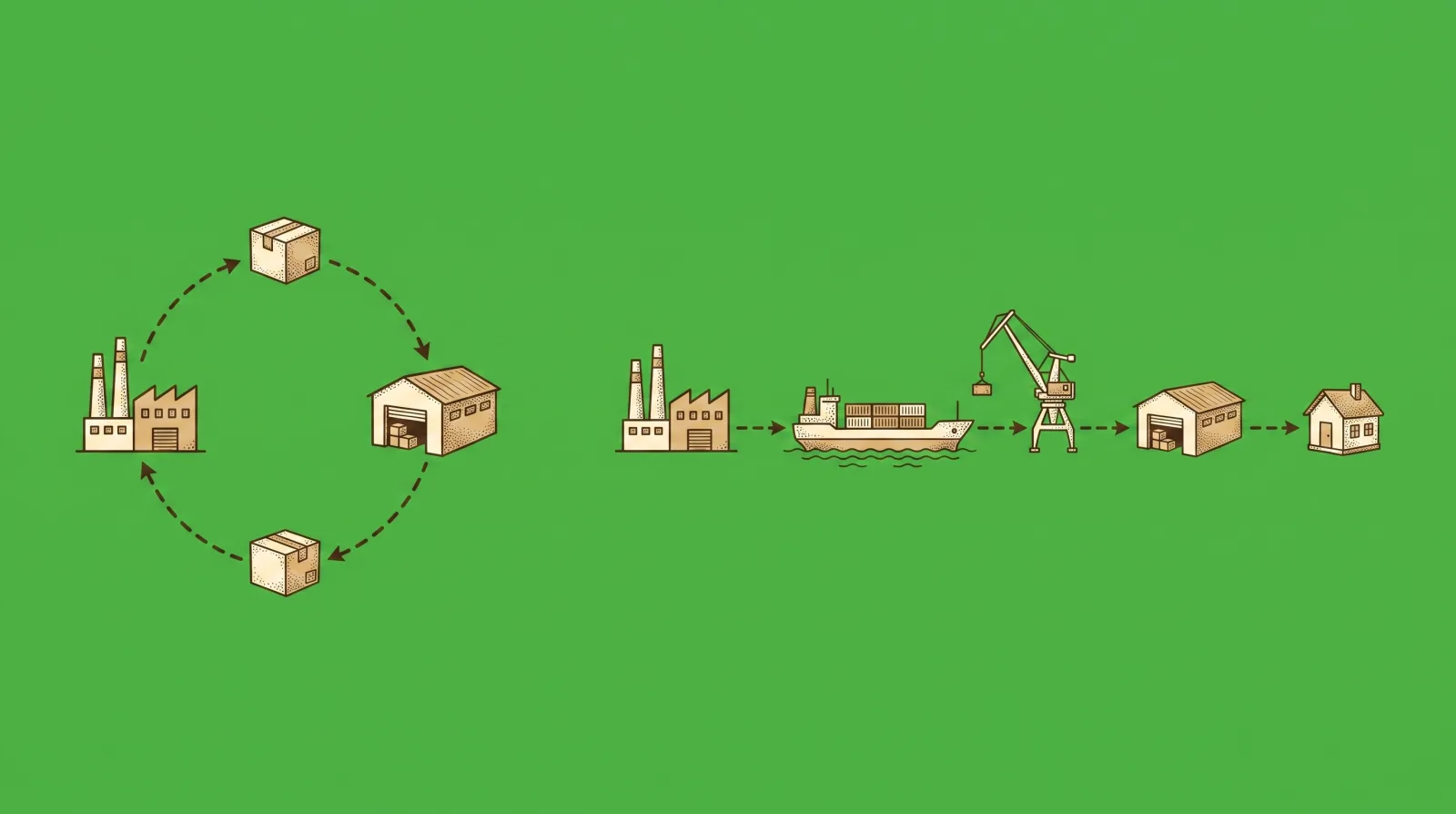
Route one, the US or EU warehouse. You pay the factory for a bulk run, pay ocean freight (the composite Drewry World Container Index stands at $4,339 per 40ft container, with Shanghai to Los Angeles at $6,244 and Shanghai to Rotterdam at $4,425, assessed 13 August 2026), pay import duty on the entire shipment at the border, pay receiving, then pay storage every month while it sells. Every one of those costs lands before the first customer pays you.
Route two, fulfillment from the source. The goods are already in the country where they were made. There is no ocean leg to prepay, no bulk customs entry, and no month-three storage bill on stock that has not sold. Cost attaches per order, after the order exists. Duty is still paid, per parcel, under the 2026 rules in the next section, but it is paid on sold goods rather than on a forecast.
The difference is not that one route is cheap and one is expensive. It is when the money leaves, and whether it ever comes back. Which brings us to the number most brands have never measured.
The months your cash spends frozen, measured
A store can be profitable on paper and still die of cash. The mechanism is inventory, and the public data lets us put months on it.
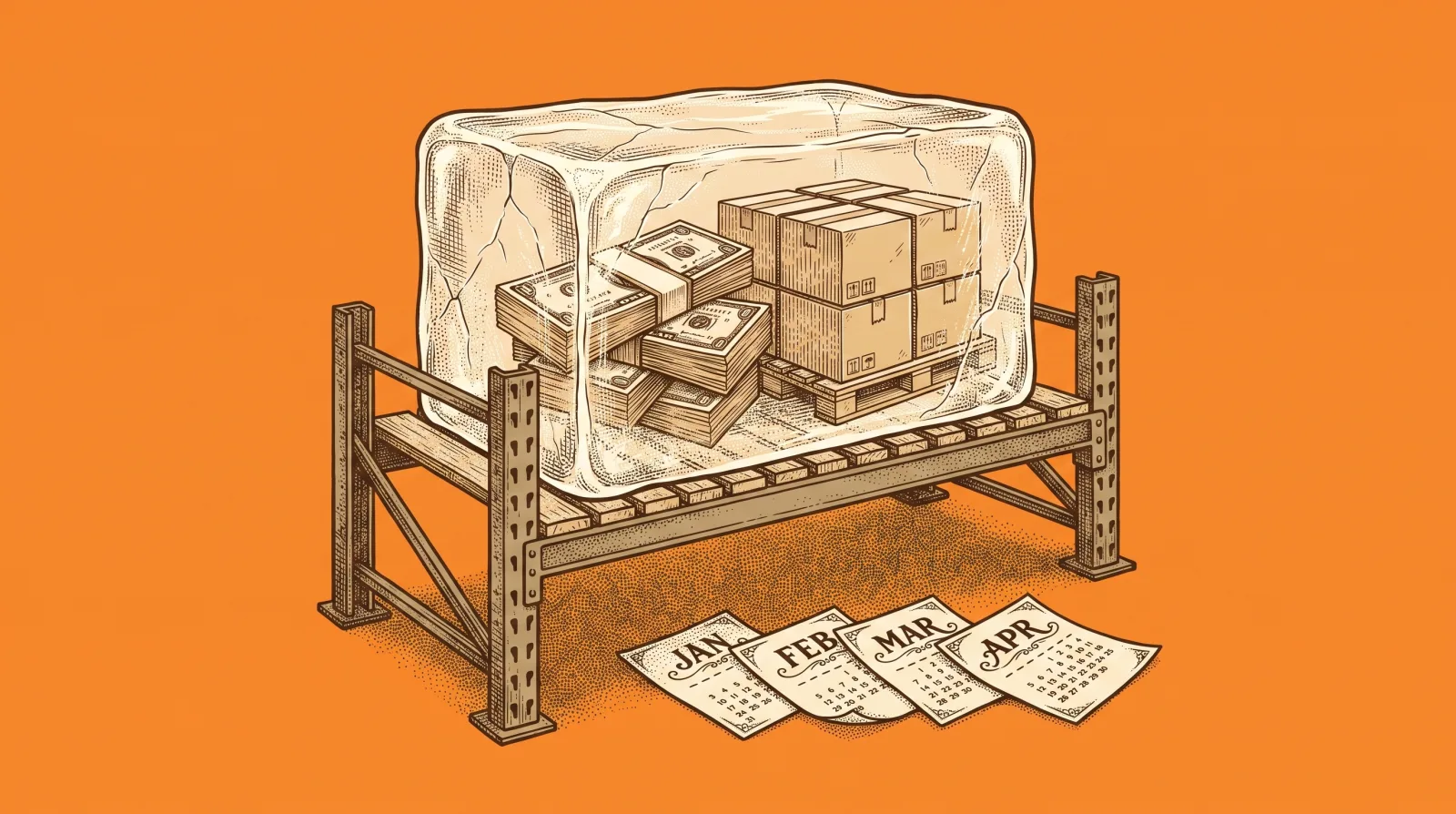
- The ocean leg. Door-to-door sea freight from China runs 30 to 40 days in normal conditions, and Flexport's live indicator currently measures 37.6 days to the US West Coast and 66.1 days to the East Coast from cargo-ready to destination port (week to 10 August 2026). Your cash is inside the container the entire time.
- The shelf. US retailers hold about 1.25 months of sales as inventory at the store stage (US Census Bureau, June 2026). For clothing retailers it is 2.14 months. That stock has been paid for and is waiting to become revenue.
- The production run sits on top of both, and it starts the clock: your money leaves at the deposit, before the container even exists.
Stack those and an import brand routinely faces three to four-plus months between paying its factory and selling through the goods, using only the documented legs. The giants engineer their way out of this: the top 1,000 US companies run a cash conversion cycle of just 37 days, helped by paying their own suppliers in 59 (The Hackett Group, 2025). A small brand gets no such terms. It prepays the factory and waits.
This is the argument our whole model is built on, and the cash-flow math post works it through order by order. Fulfillment from the source does not shorten production. What it removes is everything after: the ocean month, the shelf months, and the storage meter. Restocking from the factory into our Shenzhen warehouse takes 2 to 3 days after production, so you hold far less and reorder against real sales instead of a quarterly guess.
The duty overlay that changed the math in 2026
Rate cards used to decide this comparison. In 2026, customs rules decide it just as much, and all three major markets moved.
- United States. The $800 de minimis exemption is gone: suspended by executive order effective 29 August 2025 and codified indefinitely by CBP effective 24 June 2026. Parcels from China pay duty either way now; what differs by route is whether duty falls on a whole container upfront or per parcel on sold goods. Our Section 321 post tracks the full story.
- European Union. Since 1 July 2026 the EU charges a flat €3 customs duty per item on consignments up to €150, in force until 1 July 2028 under Council Regulation (EU) 2026/382. It taxed the junk-parcel model out and left professional China-direct fulfillment standing, as we argued in the EU de minimis breakdown.
- United Kingdom. Customs duty relief on consignments of £135 or less is ending: announced at Autumn Budget 2025 and accelerated in June 2026, with the new arrangements in force by October 2028 at the latest. Point-of-sale VAT treatment continues unchanged.
The pattern across all three: regulators are done subsidising undervalued bulk-split parcels, and none of the new rules punish a consolidated, accurately declared, professionally cleared China-direct lane. The duty era rewards exactly the operators who were doing it properly before the rules forced everyone else to.
How Peregrine prices it
We publish structure, not a rate card, and the structure is the point.
Plans are Free at $0 with unlimited orders, Pro at $49, Brand at $79 per month, with zero setup fees. Storage is free on SKUs moving on normal order flow, with a low monthly rate per cubic meter only on dormant stock, so the storage meter that defines US fulfillment economics simply is not part of the model. The per-order rate is charged only when a parcel actually ships, it depends on your product and lane, and that is precisely what the shipping calculator answers with end-customer prices per destination. Goods are sourced at 0% markup on the factory price, against the 30 to 60% typical of undisclosed models.
The operational numbers behind it: sub-24h dispatch from our own Shenzhen warehouse, a 6.6-day average on Tier-1 lanes, 99.6% QC pass rate before dispatch, and 99.8% delivery accuracy across 65+ countries on the local carrier your customer already trusts. Connect your store on the Free plan, or start with China-direct 3PL fulfillment if you are moving off a domestic warehouse.
When each region actually wins
An honest pricing hub names the cases it loses. Here is the decision table we would use ourselves.
| Your situation | The honest answer |
|---|---|
| Goods made in China, customers in the US, EU, or worldwide | China-direct fulfillment. No relocation leg, no bulk duty prepay, cost per order. This is the centre of our model |
| Goods manufactured in the US or Europe | A local 3PL. Shipping them to China to ship them back would be absurd |
| A hard one-to-two-day delivery promise as your brand's core | A domestic warehouse network, and margins that can carry its storage and minimums |
| Heavy, oversized, or freight-class products | Local fulfillment. Cross-border parcel economics punish weight |
| High EU volume with next-day expectations | An EU warehouse or a hybrid, noting most EU 3PLs quote rather than publish, so get the full fee sheet |
| Testing products, wide catalog, unpredictable demand | China-direct, because the per-order model makes being wrong cheap |
| Proven bestsellers at steady volume plus a long tail | The hybrid: localize the two or three provable winners, keep the tail China-direct. This is the grown-up answer, and we run the China side of exactly this pattern for DTC brands |
The full head-to-head against the American model, with USPS zone math and the duty stack worked line by line, is in China 3PL vs US 3PL. The European market picture is in dropshipping in Europe, with lane detail on the Germany and France pages.
Frequently asked questions
How much does a 3PL cost in China?
From published provider pages as of August 2026: pick and pack from $0.80 to $0.99 per order, storage around $14.70 per CBM per month on per-CBM rate cards, receiving from zero to $0.11 per item, and typically no monthly minimums. Published rates are marketing anchors; the real bill depends on product, volume and lane.
Is a China 3PL cheaper than a US 3PL?
On published per-order numbers, substantially: $0.80 to $0.99 pick and pack against a $3.20 US survey average, with no storage meter on moving stock versus $20.17 per pallet per month plus a $517 average minimum spend. The US route buys faster domestic delivery in exchange. Which trade wins depends on where your goods are made and your delivery promise.
What is included in 3PL pricing?
Five components everywhere: receiving, storage, pick and pack, packaging materials, and last-mile shipping, plus surcharges for peak season, oversize items and special-handling goods. Quotes differ mainly in which components are visible. A quote that shows one all-in number is hiding the composition, not simplifying it.
Why do China 3PLs have no storage fees?
Because the consolidation model bills per order moved rather than per month stored. Stock that is close to the factory restocks in days, so providers hold less of it per merchant and attach cost to orders that already carry revenue. Several published China rate cards state zero receiving fees and no minimums for the same reason.
How do the 2026 duty changes affect 3PL costs?
They ended duty-free low-value parcels in the US (de minimis suspended, codified June 2026), added a €3 per-item duty in the EU (July 2026, until July 2028), and set the UK's sub-£135 duty relief to end by October 2028 at the latest. Duty is now paid on China-direct parcels in every major market; the remaining difference is paying it per sold parcel versus on a whole imported shipment upfront.
How do I compare 3PL quotes properly?
Force every quote onto the same five components, in the same currency and units (per CBM versus per cubic foot differs by a factor of 35.3), with minimum spend, contract term, peak surcharges and long-term storage triggers stated. Then model a slow month: the quote that wins at your forecast volume often loses at 60% of it.
Express vs Standard Shipping from China: When Paying for Speed Actually Pays Off
Express or standard shipping from China? See real transit times by lane, the true cost difference, and when paying for speed actually protects your margin.

China 3PL vs US 3PL: The Real Cost and Speed Math
USPS prices by where a parcel enters its network, not by where the goods were made. The same 1 lb parcel to Manhattan is $7.61 inducted in New York and $10.67 inducted in Los Angeles. The whole comparison, worked from published rate cards.

Why China-Based Fulfillment Quietly Won (And How To Use It Without Looking Cheap)
For a decade brands hid the China origin. Now they market it. The shift from US-warehouse 3PL to China-direct fulfillment, and how to do it without the cheap-dropship association.
The Drop
Five winning products every week. Real margins, real factories, ready to import.