How to Calculate Dropshipping Profit: Four Worked Examples
 By Bojan Dimov August 4, 2026 13 min read
Dropshipping profit is retail price minus landed cost, and landed cost is product cost plus shipping to your customer's country. A product that costs $6.85 from the factory and $10.30 to ship to the United States lands at $17.15. Sell it at $34.99 and you keep $17.84, a 51% margin. The number that ruins most calculations is the second one: sellers price the product carefully and treat shipping as a rounding error, when on a lot of SKUs shipping is the larger half.
Below are four scenarios run end to end, with every line shown. The same product at two weights. The same margin destroyed by one variable. What a bundle actually does to your per-unit cost. Do the math once by hand and you will never look at a product page the same way again.
The formula, and the part people skip
Two equations run everything.
Landed cost = product cost + shipping to destination. This is what one unit costs you, delivered to your customer's door. Not the factory price. Not the price on a marketplace listing. The full cost of the parcel arriving.
Profit margin = ((retail price − landed cost) ÷ retail price) × 100. Note it divides by retail, not by cost. Dividing by cost gives you markup, which is a different and much flatterier number. Plenty of stores think they run 60% margins because they calculated markup.
The part people skip is that shipping is not one number. It changes with the destination country, the weight of the parcel, and the shipping class of the product. A calculator that applies one average shipping figure to every product and every market is not calculating anything, it is guessing with decimals. That is why the scenarios below change only one variable at a time.
Watch it run
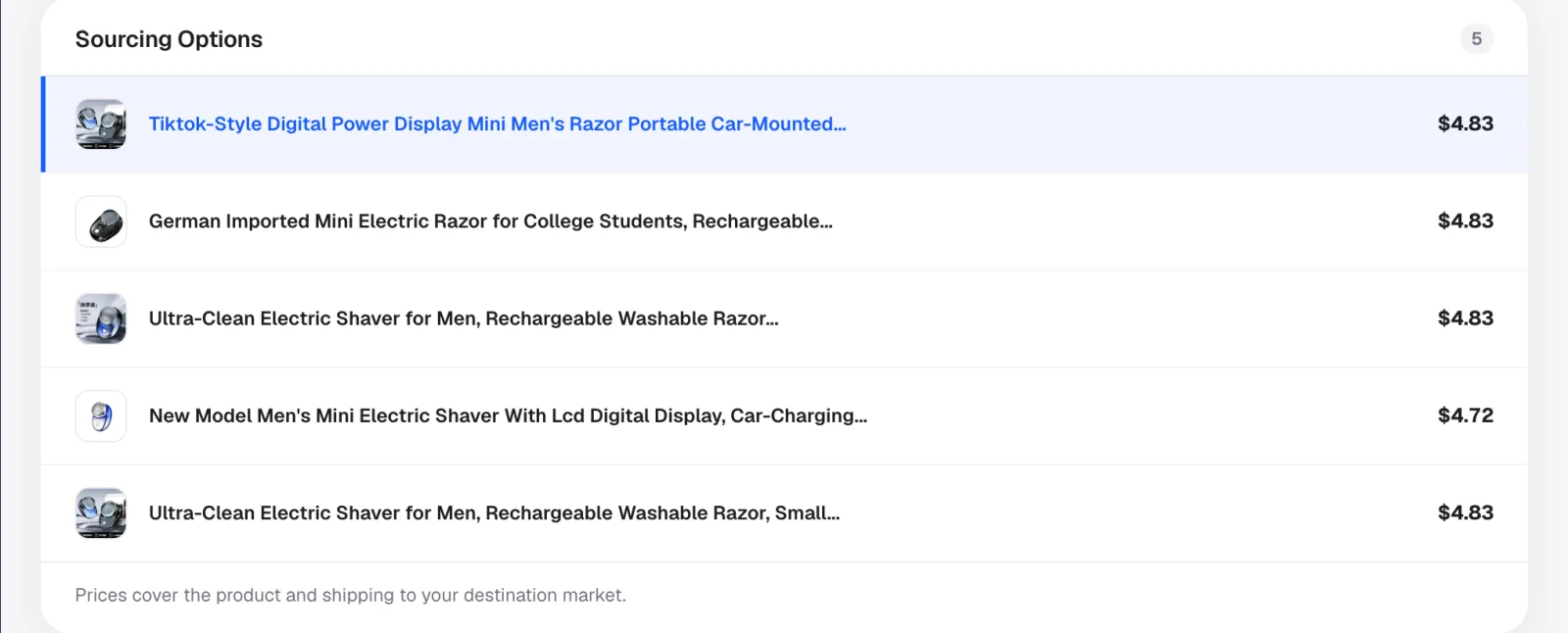
A walkthrough of the Dropshipping Calculator: a product goes in, matched factory options come back, and the landed cost and margin come out.
Scenario 1: the $9.99 impulse product
The classic low-ticket test product. Cheap, light, sells on impulse.
| Line | Amount |
|---|---|
| Product cost, factory-direct | $2.40 |
| Shipping to destination | $2.43 |
| Landed cost per unit | $4.83 |
| Retail price | $9.99 |
| Profit per unit | $5.16 |
| Margin | 51.7% |
Healthy. Now change one thing, and only one thing: source the same product through a middleman instead of factory-direct. Undisclosed sourcing agents typically add 30% to 60% on top of factory price, as we broke down in what a China dropshipping agent actually does. Take the middle of that range at 40%:
| Line | Factory-direct | Through a 40% markup |
|---|---|---|
| Product cost | $2.40 | $3.36 |
| Shipping | $2.43 | $2.43 |
| Landed cost | $4.83 | $5.79 |
| Profit at $9.99 | $5.16 | $4.20 |
| Margin | 51.7% | 42.0% |
The markup is $0.96 a unit. That looks small until you annualise it. At 500 orders a month it is $480 a month, or $5,760 a year, taken out of the thinnest part of your business, and it never appears as a line item anywhere. It is inside the product price. This is the entire reason we source at 0% agent markup and publish the factory price.
Scenario 2: the $34.99 winner where shipping is 60% of cost
A mid-ticket product with a real margin. These are the SKUs that build a brand.
| Line | Amount |
|---|---|
| Product cost, factory-direct | $6.85 |
| Shipping to United States | $10.30 |
| Landed cost per unit | $17.15 |
| Retail price | $34.99 |
| Profit per unit | $17.84 |
| Margin | 51.0% |
Now look at the composition rather than the total. Shipping is $10.30 of a $17.15 landed cost. That is 60%. The thing most sellers spend their negotiating energy on, the product price, is the smaller half.
Run the lever test:
- Negotiate the product cost down 10% and you save $0.69 a unit.
- Get the shipping down 10% and you save $1.03 a unit.
Shipping is the bigger lever on this SKU, and almost nobody pulls it, because most sellers cannot see what their shipping actually costs per product until after they have sold it. That is a visibility problem before it is a negotiation problem.
The Drop
Five winning products every week. Real margins, real factories, ready to import.



Scenario 3: the same product, twice the weight
This is the scenario that kills more stores than any other, because on paper the two products look identical.
Same factory price. Same retail price. Same category, same photos, same ad creative. The only difference is that the parcel is heavier, so it prices on a different line.
| Line | Light version | Heavy version |
|---|---|---|
| Product cost | $6.85 | $6.85 |
| Shipping | $10.30 | $24.00 |
| Landed cost | $17.15 | $30.85 |
| Retail | $34.99 | $34.99 |
| Profit | $17.84 | $4.14 |
| Margin | 51.0% | 11.8% |
(Illustrative heavy-parcel shipping figure. Product and light-version numbers are the published example.)
Identical product cost, identical retail price, and the margin falls from 51% to under 12%. Scale that to a thousand orders and one of these is a business while the other is a very busy way to lose money.
The practical rule: check the weight before you fall in love with a product. Weight and shipping class are decided by the factory long before you ever see the listing, and they are effectively unchangeable once you have committed. Product research that stops at "does it look like a winner" skips the variable with the most power over your margin.
Scenario 4: the EU order after the €3 duty
Since 1 July 2026 the EU charges a flat €3 customs duty per item on low-value imports, after removing the €150 duty-free threshold. We covered the mechanics in full in the EU de minimis breakdown. For margin purposes, the maths is simple and brutal on cheap products:
- On a €10 order, €3 is 30% of the retail price.
- On a €35 order, €3 is 8.6%.
The duty did not change your product cost or your shipping. It changed which products are viable in Europe. A low-ticket impulse SKU that survived on volume no longer clears, while a mid-ticket branded product absorbs it the way it absorbs a payment fee. If you sell into Europe, run the duty as a line in your landed cost before you scale spend on anything under about €20 retail. The wider European picture is in dropshipping in Europe.
The bundle simulation
Here is the calculation almost nobody runs, and it is the one that quietly fixes a thin margin.
When two units go into one parcel, the product cost doubles but the shipping does not. Consolidation is a physical saving, and it lands entirely in your pocket.
| One unit | Two units, one parcel | |
|---|---|---|
| Product cost | $6.85 | $13.70 |
| Shipping | $10.30 | $13.90 |
| Total landed | $17.15 | $27.60 |
| Landed per unit | $17.15 | $13.80 |
(Illustrative two-unit shipping figure; the point is the shape of the curve, not the exact rate.)
Landed cost per unit drops about 20% for doing nothing except selling two of something instead of one. Priced at $34.99 each, a two-unit order returns $42.38 of profit against $35.68 from two separate single orders. Same products, same customer, $6.70 more profit, purely from parcel consolidation.
This is the real argument for bundles, volume discounts and free-shipping thresholds. Not the psychology, the freight. Every seller knows raising average order value is good. Fewer know exactly how much of that gain comes from the parcel rather than the pricing, which is why the calculator lets you simulate a multi-item order and watch the per-unit number move before you design the offer.
What a good dropshipping margin looks like
Shopify's own figures put typical dropshipping margins at 10-15% when sourcing from open marketplaces, rising toward 20-50% with vetted supplier setups.
Read those two ranges next to each other, because the gap between them is not a reward for better marketing. It is mostly sourcing structure. A 12% margin store and a 45% margin store can sell the identical product to the identical customer at the identical price. What differs is how many parties took a cut on the way, and whether the shipping was priced to the destination or averaged across the world.
Rough working benchmarks:
- Under 20%: fragile. One ad-cost increase or one duty change and you are working for free.
- 20-40%: workable, and where most competent stores operate.
- 40%+: you either have a genuinely differentiated product or you removed a middleman. Usually the second.
Three costs that break the math
- Shipping averaged instead of priced to the destination. Germany, Brazil and Australia are not one number. A blended rate flatters the easy lanes and hides the losses on the hard ones.
- Weight, discovered late. See scenario 3. It is the single most powerful variable and the one least visible during product research.
- The markup you cannot itemise. If your quote is one all-in number with no product/shipping split, you cannot tell whether you are negotiating the factory or the middleman. Any figure you calculate on top of it inherits that uncertainty. The cash-flow math of paying per order only works if the per-order number is real.
Doing this in sixty seconds
Everything above is arithmetic you can do in a spreadsheet, and for one product you should, at least once, so the relationships stop being abstract. For the fiftieth product, use the tool.
The Dropshipping Calculator is free on the $0 plan and runs the same sequence you just read:
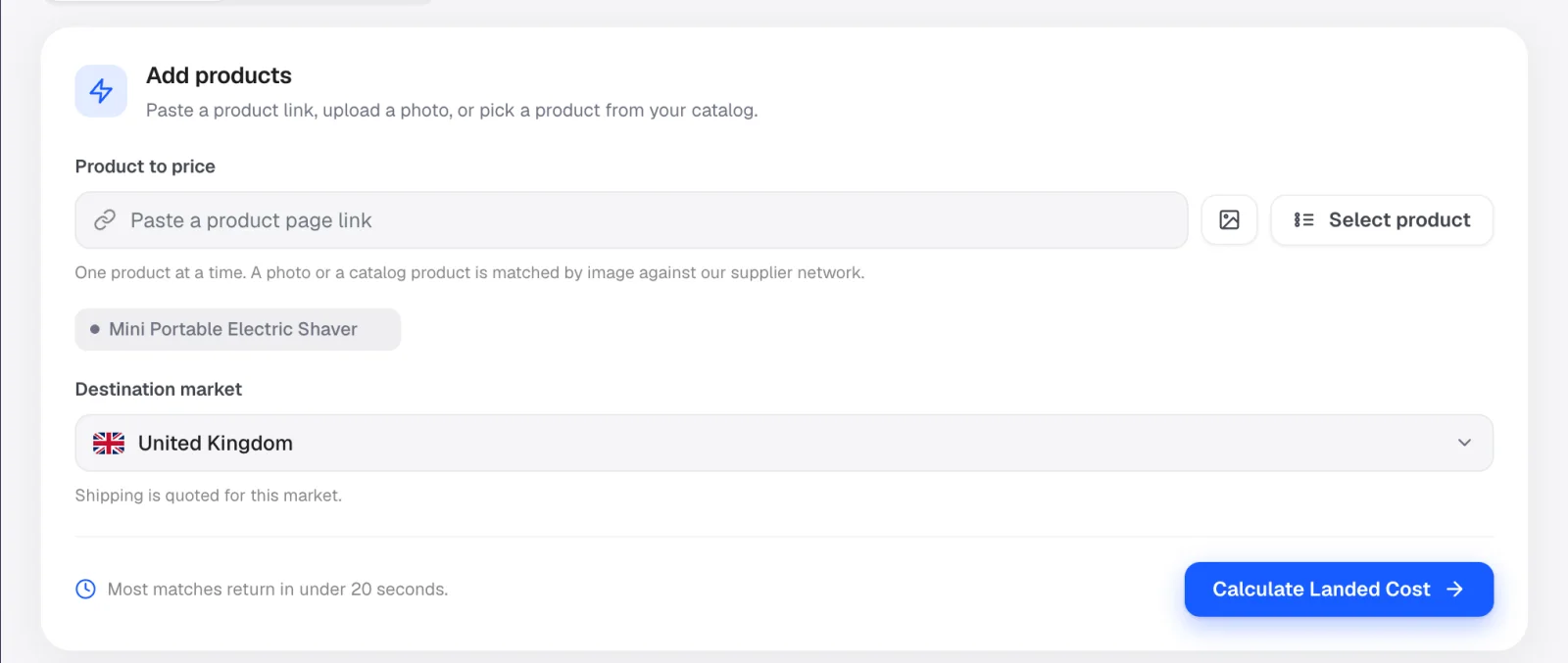
- Start three ways: paste any Shopify product URL, search by image, or pick from your own products.
- Choose the destination market, so shipping prices to that country instead of an average.
- See matched options with real photos and real variants from 30,000+ verified factories.
- Read the landed cost with product and shipping split out, per unit.
- Simulate a multi-item order and watch landed cost per unit fall.
- Set your margin and every variant prices at once.
- Publish to Shopify in four steps, with cost locked to the quote you approved.
- Save the quote and come back to it.
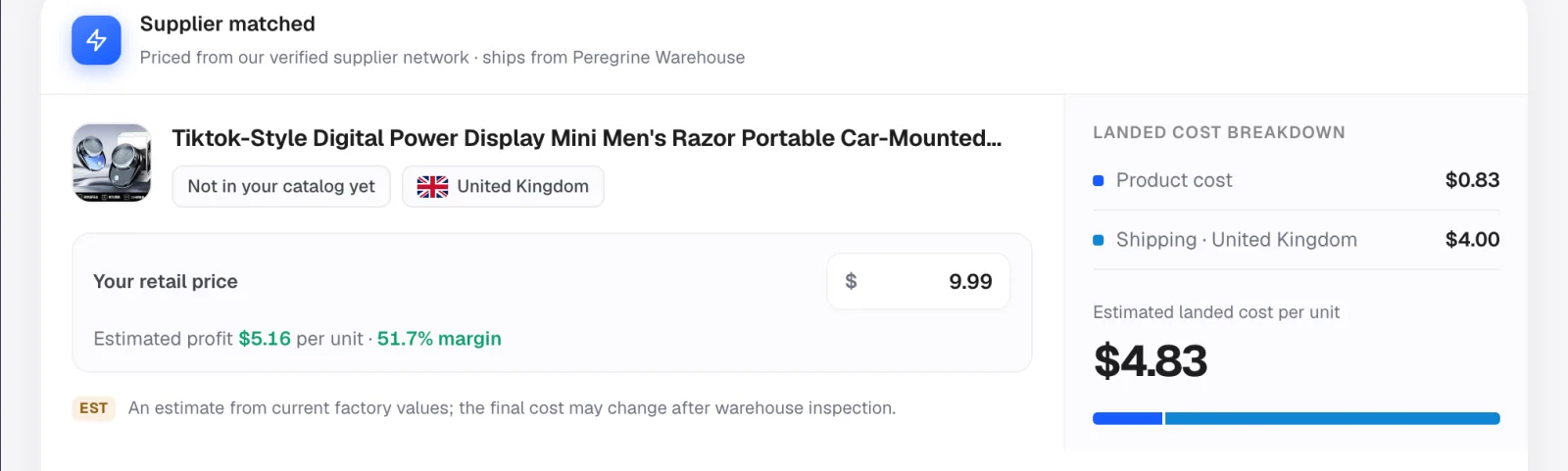
The reason the output is trustworthy is that it runs through the same pricing path your invoice runs through. The quote you see before you sell is the cost you carry after, which is the whole point of the new platform and the reason we publish our pricing instead of quoting it on a call.
Try the Dropshipping Calculator, or connect your store and price a product against your real catalog.
Frequently asked questions
What is landed cost in dropshipping?
Landed cost is what one unit costs you delivered to your customer, which is the product cost plus shipping to their country, and any import duty that applies. It is the only cost figure worth pricing against, because the factory price alone ignores the larger half of the bill on many products.
Why is shipping sometimes more expensive than the product?
Because shipping is priced on weight, dimensions and shipping class, while a small product can be very cheap to make. On the worked example, a $6.85 product costs $10.30 to ship, so shipping is 60% of landed cost. Light and small is what makes a product cheap to sell, not cheap to buy.
How does product weight affect dropshipping profit?
Heavily, and irreversibly. Two products with identical factory prices and identical retail prices can return 51% and 11.8% margins purely because one parcel is heavier and prices on a different line. Check weight and shipping class during product research, not after your first order.
Does the EU 3 euro import duty change my margin?
Yes, disproportionately on cheap products. A 3 euro per-item duty is 30% of a 10 euro order and 8.6% of a 35 euro order. It rarely breaks a mid-ticket branded product and frequently breaks a low-ticket impulse SKU.
How do bundles change landed cost per unit?
Two units in one parcel double the product cost but not the shipping, so landed cost per unit falls, roughly 20% on the worked example. That is why raising average order value improves margin by more than the extra revenue alone suggests.
What is the fastest way to check a product's margin before listing it?
Paste the product link into the Peregrine Dropshipping Calculator, pick your destination market, and read the landed cost and margin at your intended retail price. It is included on the Free plan.

Best Dropshipping Agents in 2026: An Honest Comparison From Inside the Industry
Nine agents and platforms scored against six checks that predict whether a supplier holds up at scale, using only what each company publishes on its own site. Peregrine is one of the nine, scored by the same rules, including the check where it falls short.
Dropshipping vs DTC Brand: Which Should You Start in 2026 (and How Each Works From China)
Dropshipping versus private label is usually framed as a choice. It is really a sequence: test demand per order with almost no capital, then brand the winners on the same rails. Real startup costs, published margins, and the graduation path, side by side.
ShipBob Alternative for China-Sourced Brands: When a US 3PL Stops Making Sense
ShipBob runs 50+ fulfillment centers and reports 99.97% accuracy. If your product is made in China, here is the honest cost and cash-timing comparison.
The Drop
Five winning products every week. Real margins, real factories, ready to import.