
Allocate one account’s fulfillment charges to the correct Shopify stores
Join billed order references to their shops when multiple stores use the same wallet or repeat a Shopify order number.
On this page
Use with AI
Billing records wallet movements at account level. To prepare separate store reports, start with the posted charges and match the underlying orders to their shops. A deposit into a shared wallet does not establish which shop spent it.
- North store · #1050
Match the billed Peregrine reference to its North store record.
- South store · #1050
Use its separate Peregrine reference and item lines.
- Account-level funds
Keep wallet funding outside the store fulfillment expense totals.
Reconcile a reporting period
- Open Billing, select the period and choose Export → Charges (CSV). This file is scoped to the selected period. Keep its original order and SKU identifiers.
- Open Orders and find each billed Peregrine order reference. Check its store and original Shopify order. If two stores both use order #1050, use the Peregrine reference and store together.
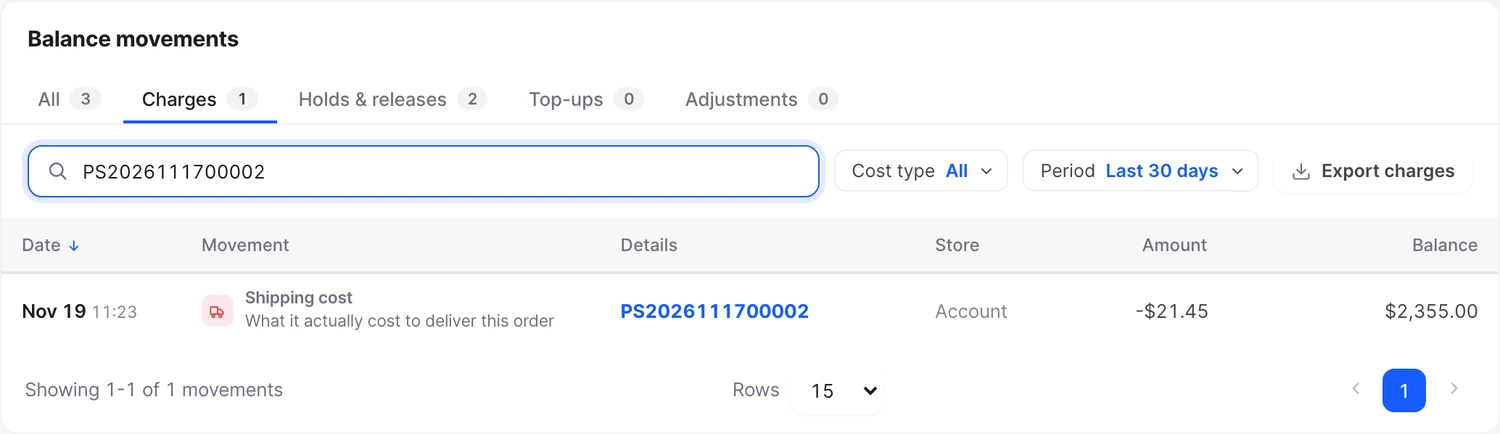
The filtered charge identifies a Peregrine order and shows Account in Store. Find this same Peregrine reference in Orders before assigning its cost to a shop.
Platform screenshot · Example dataView full size - In your working file, add a store column and keep sourcing and shipping rows separate. Multiple SKUs can belong to a single order. Group the rows only after assigning the store.
- Keep account-level adjustments, cash deposits and unidentifiable references in a separate reconciliation line. Ask support to identify a specific row before allocating it.
To check the result, add the store charges and your unassigned charge rows for that period and compare them with the original charge file. A Shopify order date in October and a November shipping charge can legitimately land in different reports.
Common questions
Why does the Store column in Billing say Account?
The ledger entry belongs to the wallet. Use the linked order evidence to determine the selling shop.
Can I split every top-up according to how much each shop deposited?
That would track your own funding allocation. Record actual fulfillment expense from the charge rows associated with each shop's orders.
What if the same SKU is sold by two stores?
Match the order and store first. The same variant code or product name can appear in both stores' catalogs.