
Compare buying one unit per sale with ordering a batch
Work out the cash needed, what is included in each quote and how many units you can reasonably expect to sell.
On this page
Use with AI
Ask for two written offers against the same variant, pack and destination. One offer covers sourcing when a buyer orders. The other covers purchasing a stated quantity in advance. A lower unit price changes both the cash you put in today and the stock you still need to sell.
- Per sale
Unit goods quote, packed destination rate, availability and any per-order charges.
- Batch purchase
Quantity per exact variant, goods total, inbound, pack setup and accepted sellable count.
- Either option
Price the same outbound parcel and check who bears changes in weight, packaging or destination.
Compare the cost components
| Ask for | Purchased per sale | Purchased as a batch |
|---|---|---|
| Goods | Price for one available size/color | Batch total, units per variant and minimum per color |
| Arrival at the warehouse | Check what the unit offer includes | Freight, any preparation and counts accepted for sale |
| Shipment to the customer | Price one packed retail order | Price the same packed retail order from received stock |
| Branding | Confirm standard pack and per-order additions | Separate one-time setup, purchased packaging stock and per-order additions |
Test the cash decision with a small example
Suppose goods cost $8 per unit when sourced per sale. A batch of 50 is quoted at $300, with $50 inbound. In this simplified example the brand pays $350 upfront. If all 50 units are accepted and eventually sell, goods plus inbound are $7 per unit. If only 20 sell, $160 would have bought those 20 per sale. The batch still ties up the rest of its cost in the 30 units on hand. Enter your actual volumes, chargeable extras and stock losses in the same comparison.
Confirm the switch for existing orders
List any open orders with goods already purchased. Ask which future orders will use your owned stock and when the change takes effect. Once stock is received, open one fulfilled order in Orders and note its store and order reference. In Billing → Balance movements → Charges, match the associated goods or fulfillment entry to your agreement.
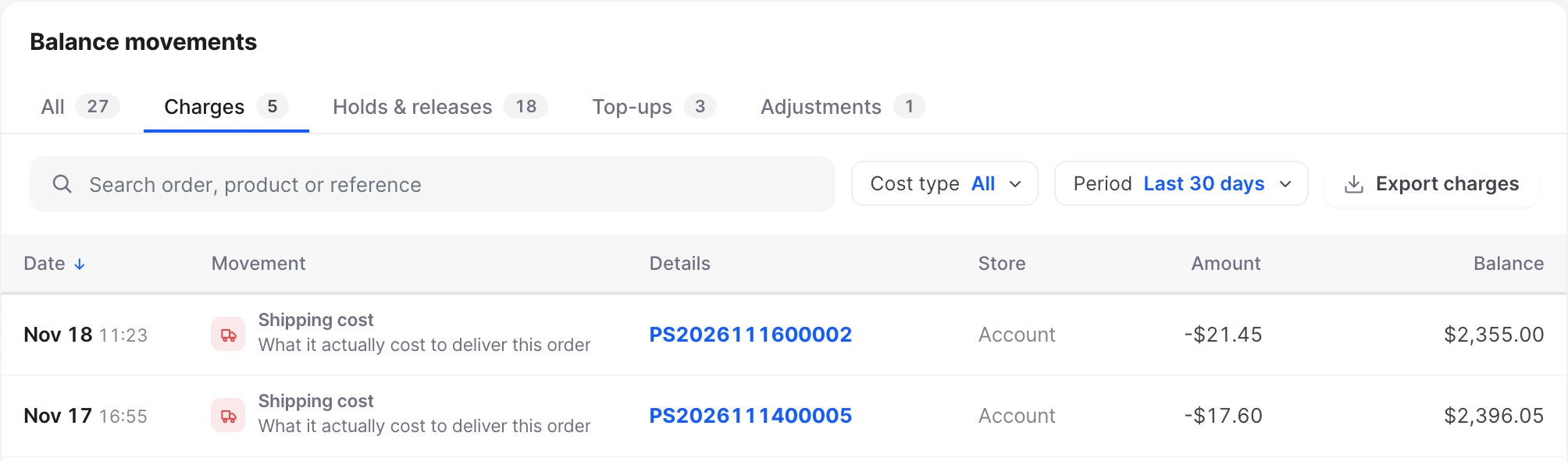
After switching to owned stock, use Charges in Balance movements to reconcile the first fulfilled order against the agreed goods treatment.
Common questions
The supplier offers a minimum of 50. Can I split that across sizes?
Ask for the minimum at the product, color and variant level. Obtain the accepted split in writing before budgeting the batch.
Does a cheaper per-unit product make shipping cheaper too?
Measure the packed order after the change. A new rigid box can change its chargeable size even when the product stays the same. Check a packed parcel
Which option is better if I am testing a design?
Compare the cash you could leave in unsold variants, the availability of single-unit supply and the dispatch promise you can keep. Repeat the comparison using sales of each size and color after the first few orders.